Investment
Hyderabad Real Estate Investment Guide
How the city is structured, which corridors do what, and a process for deciding — without the return projections nobody can honestly make.
27 July 20269 min read

Hyderabad has been one of India’s more active property markets for over a decade, and that has produced a lot of confident forecasting. This guide deliberately avoids it. Nobody can tell you what a specific property will be worth in 2033. What can be described accurately is how the city is structured, what drives demand in each part of it, and how to run a decision process that survives being wrong about the timing.
Why the city grew the way it did
Three things shaped the current map.
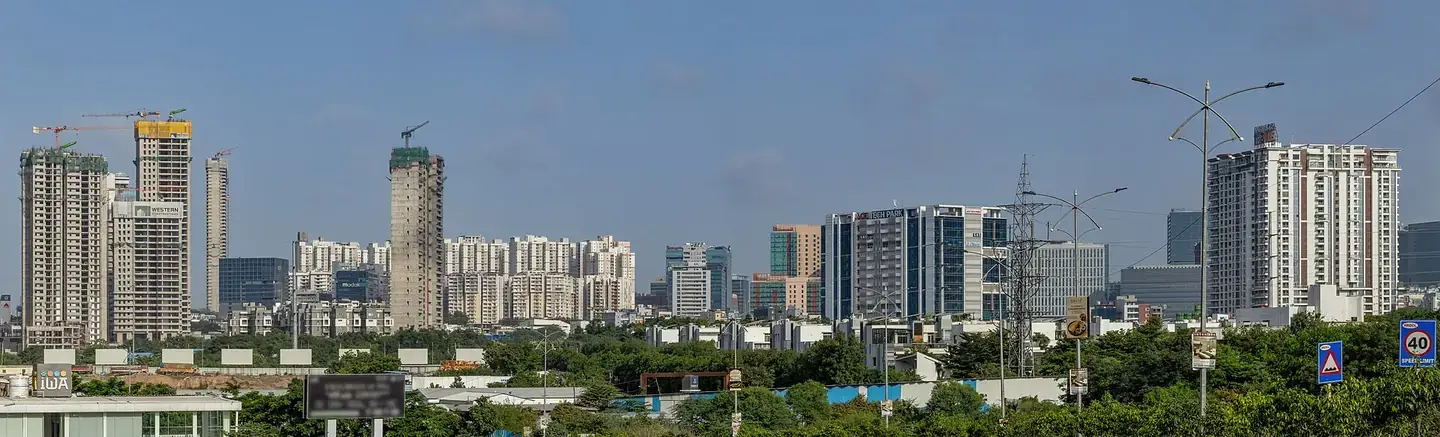
The IT corridor. Employment concentrated heavily in the west — HITEC City, Gachibowli, the Financial District, Nanakramguda. Residential demand followed the jobs, which is why western-side pricing carries a premium.
The Outer Ring Road. A 158-km ring that made peripheral land genuinely accessible. Locations that were remote before the ORR — Kokapet, Narsingi, Tellapur, Kollur — became commutable, and pricing re-rated accordingly. ORR proximity remains one of the more reliable predictors of interest in a layout.
Metro and road infrastructure. The metro reshaped demand along its corridors. Announced extensions tend to move sentiment before they move concrete, which cuts both ways: buying on an announcement means carrying the risk of the timeline.
The corridors, and what each is good at
West (Gachibowli, Kokapet, Narsingi, Nanakramguda). Highest pricing, deepest rental demand, best liquidity. Buy here for occupancy and exit-ability, not for a low entry price.
Far west (Tellapur, Kollur, Osman Sagar side). High-rise supply at scale. The decision is possession-timeline arbitrage. Developer delivery record is the dominant variable.
Western fringe (Mokila, Shankarpally, Chevella). Plotted development and farm land. Long horizon, low holding cost, diligence-heavy.
North (Kompally, Medchal, Bahadurpally). Better area per rupee, established social infrastructure, lower commute convenience for western-corridor workers.
East (Kapra, Uppal, Pocharam). Most accessible pricing among serviced areas. A yield and affordability story.
Central and old city (Tolichowki, Mehdipatnam, Langar Houz). Mature and central. Steady rather than sharp, with consistently good rental demand.
What actually drives value in a specific location
Rather than asking whether an area will “grow”, ask what would have to be true for it to:
- Employment within a reasonable commute. Is there office stock nearby, or is the nearest employment 40 minutes away?
- Confirmed infrastructure, not announced infrastructure. Distinguish between an ORR interchange that exists and a metro line that has been proposed.
- Water. In several Hyderabad corridors this is the binding constraint on how much development a layout can absorb.
- Approved supply pipeline. A great deal of upcoming supply in the same micro-market is your future competition at resale.
- Social infrastructure. Schools and hospitals arriving is what turns a layout into a neighbourhood, and it shows up in rental demand.
A process that works
1. Decide what the money is for. Rental income, capital appreciation, a future home, or diversification. These point at different assets, and trying to satisfy all four produces a compromise that satisfies none.
2. Set the real budget. Purchase price plus stamp duty and registration, GST where applicable, brokerage, interiors, and a contingency. Then subtract what you need to keep liquid. What remains is the actual budget.
3. Fix the horizon honestly. Under three years, residential property is a poor instrument — transaction costs alone are punishing. Three to seven years favours completed, rentable apartments in liquid locations. Beyond seven, plotted development becomes reasonable.
4. Shortlist three locations, not ten. Then visit each one twice: once at peak hour, once on a weekend.
5. Compare on carpet area and total cost, never on super built-up rate. Loading factors differ enough between projects to invert a comparison.
6. Do the diligence before the advance, not after. Title, encumbrance certificate, approvals, RERA registration, occupancy certificate. Use your own lawyer.
7. Underwrite the downside. What happens if possession slips two years, or if you need to exit in year three? If either answer is unacceptable, it is the wrong property regardless of the upside.
What to be sceptical about
- Guaranteed rental or assured-return schemes. The guarantee is only as good as the guarantor, and it is usually priced into the purchase.
- Percentage appreciation projections. Nobody has this information.
- “Pre-launch” pricing without RERA registration. The discount is compensation for risk you may not be able to assess.
- Pressure to decide today. Genuine opportunities survive a week of diligence.
What Hyderabad genuinely offers
A large and diversified employment base, infrastructure that has been built rather than only announced, and a wide spread of price points across corridors — which means there is usually a location that fits a given budget and horizon, rather than one entry price for the whole city.
That is a reasonable foundation. It is not a guarantee, and any specific property still has to be underwritten on its own facts.
If you want to work through your budget and horizon against specific locations, message us and we will go through it properly.